 how-to
How to Clear Deep Sewer Clogs: Step-by-Step Guide
Table of Contents
- Main Sewer Line Clog Symptoms: How to Tell It's Not Just a Sink
- Causes of a Clogged Sewer Line You Can Actually Fix
- What You'll Need Before You Start
- Step 1: Find the Cleanout and Open the Cap Safely
- Step 2: Use a Drain Snake for Main Sewer Line Blockages
- Step 3: Break Up the Blockage and Flush the Line
- When to Stop and Call a Professional
- Hydro Jetting Sewer Line Service: What It Clears That a Snake Can't
- Frequently Asked Questions
Last Updated: October 6, 2026
Main Sewer Line Clog Symptoms: How to Tell It's Not Just a Sink
To clear deep sewer clogs, first confirm the clog is deep: one slow sink is local, but trouble across several fixtures points to the main line.
The pattern is consistent: a toilet gurgles when the tub drains, the kitchen sink backs up when the washing machine empties, and water rises in the lowest drain first.
Those are main sewer line clog symptoms.
Localized Clog vs. Deep Main Line Blockage
A localized clog blocks one branch line serving a single fixture. A deep main line blockage blocks the main sewer line carrying everything from the house to the street.
The two behave differently:
- One slow drain: usually local, often hair or grease
- Several slow drains: usually the main line
- Sewage smell in the basement: main line
That distinction decides everything: snaking a branch line when the main is blocked wastes an afternoon.
EPA guide to household wastewater and septic systems
Causes of a Clogged Sewer Line You Can Actually Fix
The causes of a clogged sewer line fall into two groups: what you can clear yourself, and what needs a pro.
Grease is most common: it pours down warm, cools, sticks to the pipe wall, and every later flush adds another layer.
Wipes are second: even "flushable" wipes do not break down like toilet paper, catching on rough spots and collecting everything behind them.
Then there are the ones you cannot snake away:
- Tree roots that have entered a cracked joint
- A collapsed or offset pipe section
- Heavy scale buildup from years of mineral deposits
If your clog returns every few months, you are likely in this second group.
What You'll Need Before You Start
Gather your tools before you open anything, a mid-job hardware store run is how most DIY attempts stall out.
Total time: 1 to 2 hours for a straightforward main line clog.
Difficulty: Moderate. You need some upper body strength for a manual snake.
Here is the basic kit:
- Work gloves and safety glasses
- A drain snake or sewer auger with at least 25 feet of cable
- A bucket and old towels
For a main sewer line, a hand-crank drum auger under 25 feet is usually too short. Rent or buy a powered auger if the cleanout sits far from the blockage.
Step 1: Find the Cleanout and Open the Cap Safely
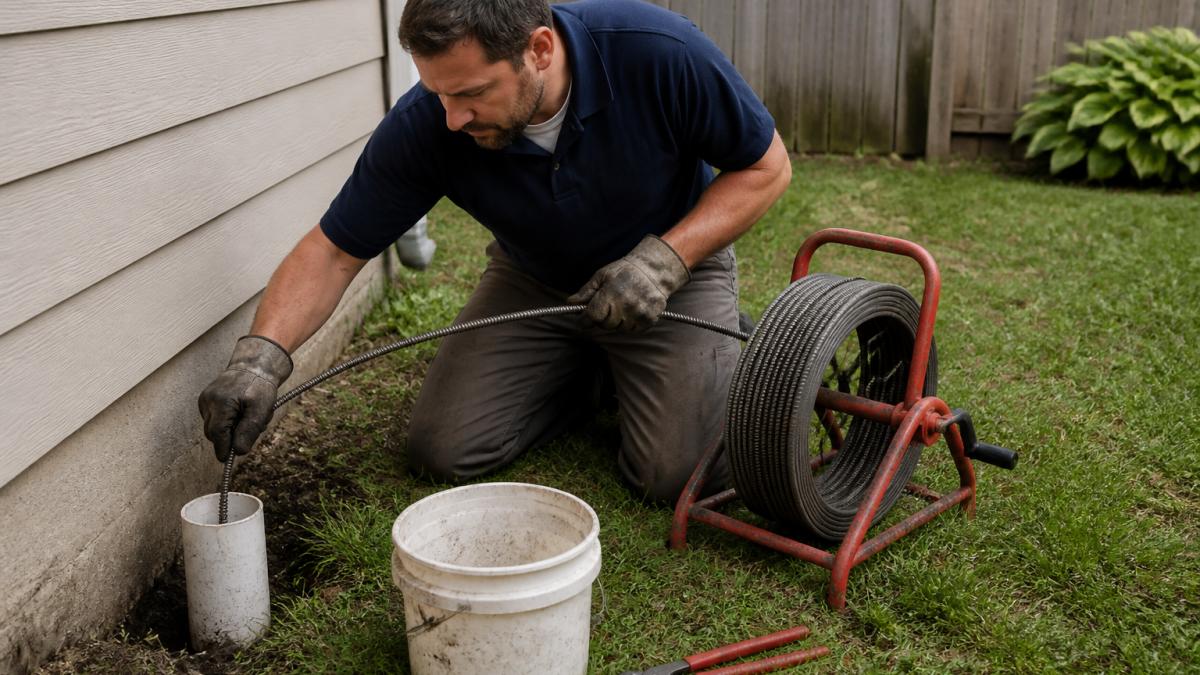
The cleanout is a capped pipe, usually 3 to 4 inches wide, giving direct access to the main drain.
Look for a white or black plastic cap just above the grass or flush with a concrete floor; older homes may have brass.
Turn the cap slowly with a wrench. If it will not budge, do not force it with a hammer.
Step 2: Use a Drain Snake for Main Sewer Line Blockages
A drain snake for main sewer line work is not a sink snake. You need a longer, thicker cable that travels the full run to the blockage.
The rule of thumb: match the cable to the pipe and the distance.
Clog Type | Best Tool | Why |
|---|---|---|
Soft clog close to cleanout | Hand drum auger, 25-50 ft | Light, cheap, easy to control |
Soft clog far down the run | Powered sectional auger | More torque over distance |
Tree roots | Powered auger with root cutter head | Cuts rather than pushes |
Grease and scale | Hydro jetting | Scours the full pipe wall |
Feeding and Operating the Auger Cable
Feed the cable slowly. Rushing is the single most common mistake.
- Push the cable into the cleanout by hand for the first few feet.
- Tighten the chuck or thumbscrew to lock the cable.
- Turn the crank or trigger the motor while pushing forward.
- When you feel resistance, keep turning but ease off the forward pressure.
- Loosen the chuck, pull back a foot, re-tighten, and feed again.
You will feel the cable hit the blockage: it stops advancing and the motor load rises. Do not force it, let the turning head work into the clog.
If the cable kinks, stop. A kinked cable will not pass the bend and can damage the pipe.
Step 3: Break Up the Blockage and Flush the Line
Once the cable breaks through, you are not done, you made a hole, not cleared the pipe. Most repeat clogs happen because the homeowner stopped at the first sign of drainage without verifying the line was open.
Pull the cable out slowly and watch what comes with it. Grease and hair show what you were fighting; roots mean the clog will return; grit or soil flags a broken or offset pipe that snaking cannot fix.
How to Confirm the Clog Is Actually Cleared
A drain that gurgles down for thirty seconds is not proof. Run this verification sequence:
- Fill and release the lowest fixture. Fill a tub or laundry sink to the top, then pull the stopper and time how long it takes to empty. A main line that is truly clear will drain a full tub in roughly the same time it did before the clog started.
- Run multiple fixtures at once. Turn on the tub, the washing machine, and a bathroom sink together. If any one of them backs up or slows while the others run, the line is still partially blocked.
- Watch the cleanout. With the cap off and water running, you should see steady, unobstructed flow past the cleanout. If water stands still or rises, stop and snake again.
- Check for gurgling. A toilet that gurgles when the tub drains is still signaling a restriction somewhere in the shared line.
- Listen at the cleanout. A clear line has a steady, low rush of water. A partially blocked line has an uneven, pulsing sound as water pushes past debris.
If any check fails, run the snake again, a second pass often opens what the first only poked through. Feed the cable to the same distance, work the head through the restriction, and repeat the verification.
When to Bring In a Camera
A cable can pass right over roots, cracks, offsets, and heavy scale without clearing them. If you have snaked twice and water still drains slowly, or the clog returns within days, a sewer camera inspection is next.
A camera inspection is the difference between a lasting fix and a repeat visit, and the only way to confirm a line is fully clear before closing the cleanout.
When to Stop and Call a Professional
DIY sewer work has a hard ceiling. Past a certain point, continuing risks a broken pipe, a sewage backup, or injury. Knowing where that line sits is the most important skill in this guide.
Stop Immediately If Any of These Are True
These are not "try harder" situations. Stop, close the cleanout if you can, and call a professional.
- Sewage is backing up into the basement or lowest floor. This is a health hazard, not a clog. Evacuate the affected area, avoid contact with the water, and call a professional.
- You pull back roots, mud, or soil on the cable head. Roots mean the pipe has an opening. Soil means the pipe may be broken or collapsed. Snaking will not fix either.
- The cable will not pass a certain point after two or three attempts. A hard stop usually means a collapsed section, a severe offset, or a heavy root mass that a hand or sectional auger cannot cut.
What a Professional Service Actually Includes
When you call a plumber for a deep main line clog, you are not just paying for a snake. A typical service call includes:
- Diagnosis. Locating the cleanout, confirming the clog is in the main line, and identifying the likely cause.
- Cleaning. Snaking, augering, or hydro jetting depending on the clog type and pipe condition.
- Camera inspection. Verifying the line is clear and checking for roots, cracks, offsets, or scale.
Costs vary by region, pipe length, and access, but the pattern holds: cleaning and camera inspection cost a fraction of a repair, and a repair a fraction of full replacement. Stopping early and getting a camera on the line is almost always cheaper.
Emergency vs. Non-Emergency
Not every clog is an emergency. A single slow drain with no backup can wait for a scheduled visit, but a sewage backup, multiple affected fixtures, or any sign of a collapsed pipe is an emergency. If unsure, call, a diagnostic visit is far cheaper than water damage.
CDC guidance on sewage exposure and cleanup safety
Hydro Jetting Sewer Line Service: What It Clears That a Snake Can't
Hydro jetting sewer line service uses high-pressure water, not a cable.
That difference matters for grease, scale, and roots. A snake leaves a ring of buildup behind.
Here is when hydro jetting is often recommended over snaking:
- Grease-heavy lines, especially from restaurants
- Repeated clogs in the same spot
- Root intrusion that has been cut but not flushed out
CDC guidance on sewage exposure and cleanup safety
Jetting is not right for every pipe. Old, fragile, or already-cracked lines can be damaged by high pressure.
A common mistake is treating every clog the same.
Affordable Drain is a family-owned, non-franchise business serving Canton and the surrounding areas since 1999.
Get started with Affordable Drain.
Frequently Asked Questions
Can I pour vinegar or baking soda down the drain to clear a deep sewer clog?
Vinegar and baking soda can loosen light buildup in a sink or tub drain, but they will not clear a deep main sewer line clog. A blockage several feet down the pipe, especially one caused by tree roots or a broken pipe fitting, needs a drain snake or professional equipment. Chemical drain cleaners are also risky in main lines because they can damage older pipes and sit in standing water without reaching the clog. If a single drain is slow, try vinegar and baking soda first. If multiple drains back up, skip the home remedies and move to snaking or call a plumber.
How do I know if the clog is in the main sewer line and not just one drain?
Watch how many fixtures are affected. A single slow sink or tub points to a localized clog in that branch line. When a toilet, sink, and tub all drain slowly at the same time, or when sewage backs up into the lowest drain in the house, the blockage is in the main sewer line. Gurgling sounds from other drains and water rising in the shower when you flush the toilet are also signs of a main line clog. These main sewer line clog symptoms mean the problem sits past the point where your household drains join together.
Can a drain snake reach a clog deep in the main sewer line?
A manual drain snake for a main sewer line usually reaches 25 to 50 feet, which covers most residential runs from the cleanout to the city connection. If the clog sits farther out or the line is longer, you need a powered sewer auger with more cable. Feed the cable slowly, turn the snake clockwise, and let the auger do the cutting rather than forcing it. If the cable stops moving before it reaches the blockage, or if you hit a hard stop that feels like a broken pipe, stop and call a professional before you damage the line.
When should I call a plumber instead of clearing the clog myself?
Call a professional if you have tried snaking from the cleanout and the water still will not drain, if sewage is backing up into multiple fixtures, or if you smell gas or see standing water around the cleanout. Recurring clogs within a few months often point to tree roots, pipe damage, or a failing pipe fitting that snaking cannot fix. A plumber can run a camera inspection to confirm the blockage is fully cleared and identify cracks, root intrusion, or bellies in the line. Hydro jetting sewer line service also removes grease and scale that a snake leaves behind.